| Class | Adamantane derivative |
|---|---|
| CAS | 87913-26-6 |
| Molar Mass | 306.25 g/mol |
| Chemical Formula | C16H20BrN |
| IUPAC Name | N-(4-bromophenyl)adamantan-2-amine |
| Synonyms | 2-bromophenyl-1-amino adamantane, bromontan, 87913-26-6, Bromantan, N-(2-ADAMANTYL)-N-(4-BROMOPHENYL)AMINE, N-(4-bromophenyl)adamantan-2-amine, UNII-N1ILS53XWK, 2-(4-Bromophenyl)aminoadamantane, N1ILS53XWK, C16H20BrN, Ladasten, PubChem21584, AC1NFLP6, MolPort-012-150-352, ZINC2577057, N-(4-bromophenyl)-2-adamantanamine, AKOS004120981, MCULE-9093089711, AS-54469, N-(2-adamantyl)-N-(p-bromophenyl)-amine, FT-0663607, N-(4-BROMOPHENYL)TRICYCLO[3.3.1.1(3,7)]DECAN-2-AMINE, 138308-72-2, O035, A842407 |
| Storage | Store at room temperature, tightly sealed, away from heat, light and moisture. Do not refrigerate. |
| Solubility | Soluble in Chloroform (Slightly), Ethyl Acetate (Slightly), PEG400 (Moderately), Caprylic acid |
| Organoleptic Profile | Clear liquid |
| Physical Form | Liquid, solved in Caprylic acid |
| Specification | 90mg/mL±10% in 18mL, purity 99%+. Chemical analysis available on request. |
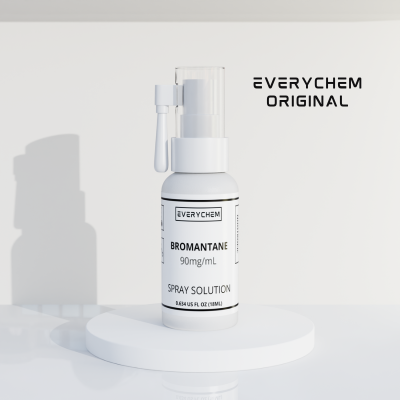
Bromantane – Spray Solution (90mg/mL)
$34.99
✓ High quality reference material
✓ Contains 180 sprays per bottle
✓ Approximately 9mg per spray
29 in stock (can be backordered)
Background
Bromantane is an adamantane derivative, structurally related to amantadine. It was developed in Russia, where it was registered under the name Ladasten. In rodent studies it upregulates dopamine synthesis [1]. It is grouped with bemethyl as an actoprotector.
Pharmacology
Bromantane’s mechanism is thought to resemble amantadine’s: inhibition of Kir2.1 potassium channels [2], consistent with the structural similarity of the two compounds. It has antioxidant activity, and indirect histone deacetylase inhibition has been proposed as the route by which it raises expression of the neurotrophins BDNF and GDNF.
Pharmacokinetics
Bromantane’s absolute bioavailability is 27.5%. It has a wide volume of distribution and a half-life in brain tissue of about 7 hours. It is metabolized by cytochrome P450 enzymes to less dopaminergic, more anticholinergic compounds. Its reported LD50 is 8100 mg/kg.
References
[1] https://pubmed.ncbi.nlm.nih.gov/11109517/
[2] https://www.jci.org/articles/view/133398
Research use only
For laboratory research use only. Not for human or animal consumption, or for any medical, diagnostic, therapeutic or recreational use.